
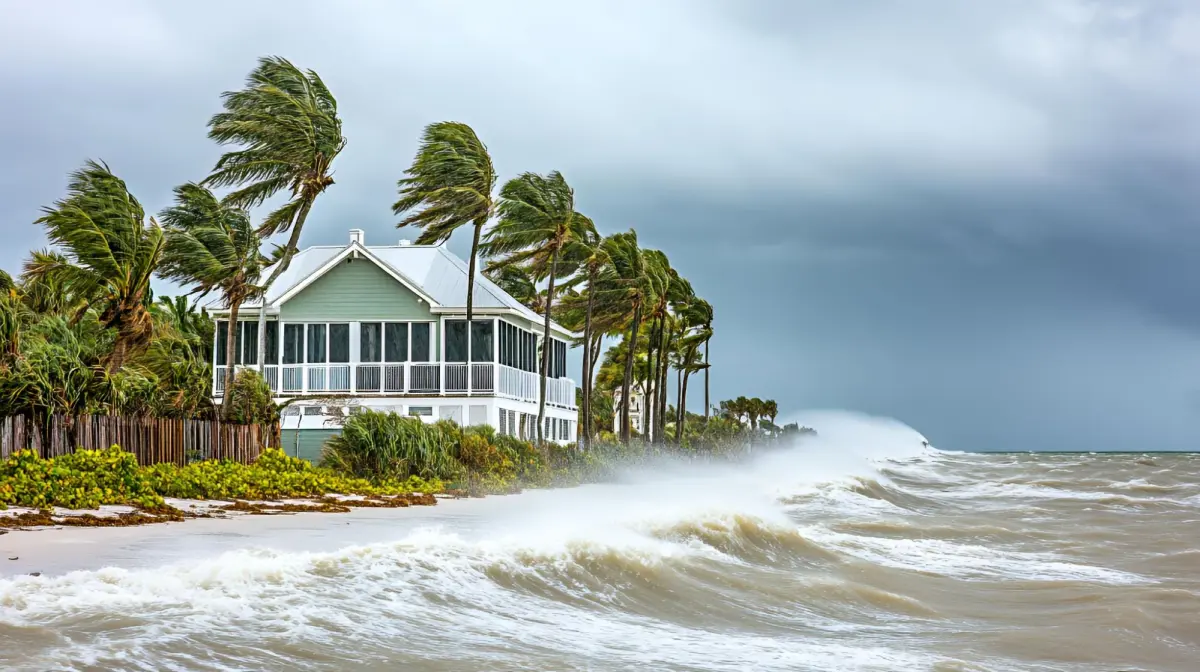
One storm hit your house. Your insurance treats it as two separate events.
That split is the whole fight. Storm surge vs wind damage insurance in St. Petersburg decides which policy pays, which deductible applies, and whether you collect anything at all.
Pinellas County homeowners learned this the hard way in 2024. Here is how the line gets drawn, and how to protect your side of it.
One storm, two policies, two sets of rules
Your homeowners policy covers wind. It pays for the roof the gusts peeled back, the broken windows, and the rain that came through those openings.
Your homeowners policy does not cover flood. Storm surge is flood. So is rising water from a canal, a bay, or a street that filled up.
Flood damage is paid by a separate policy. That is usually the National Flood Insurance Program , or a private flood carrier.
If you only carry the homeowners policy, water that came in from below is not covered. Many St. Pete homeowners find this out in the denial letter.
Helene made this a Pinellas problem, not a theory
Hurricane Helene came ashore in September 2024. The Tampa and St. Petersburg area saw 6 to 7 feet of storm surge. Milton followed about six weeks later.
Shore Acres, Riviera Bay, and the barrier island neighborhoods took water that had never reached those floors before.
Across Florida, more than 49,000 claims from Helene and Milton were denied. A large share of those denials pointed at the flood exclusion in a standard homeowners policy.
Pinellas is close to a peninsula. Almost every neighborhood sits near the Gulf, Tampa Bay, or an inland waterway. That geography is why this one line in a policy matters more here than in Orlando.
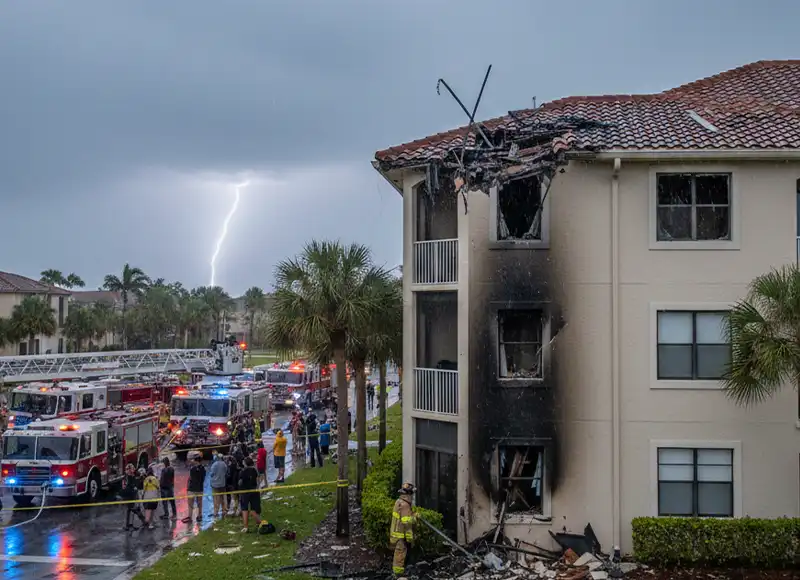
The deductible trap: you can owe two of them
Florida hurricane deductibles are a percentage of your dwelling coverage. The common options are 2%, 5%, and 10%.
On a $400,000 dwelling limit, that is $8,000 at 2% and $20,000 at 5%.
Your flood policy has its own deductible. NFIP deductibles are flat dollar amounts, not percentages, and building and contents are figured separately.
So a single hurricane can cost you two deductibles. One on the wind claim. One on the flood claim. Your hurricane deductible never applies to flood damage.
Now run the math on a split loss. If the wind portion is written at $15,000 and your hurricane deductible is $20,000, the wind claim pays zero.
That is why carriers and policyholders argue so hard over which bucket the damage lands in. Small shifts in the scope move real money.
What flood insurance will not pay for
Even a paid NFIP claim leaves gaps. Three that catch St. Petersburg homeowners:
- NFIP residential limits stop at $250,000 for the building and $100,000 for contents. Many Pinellas homes now cost more than that to rebuild.
- NFIP pays nothing for temporary living costs. If the house is unlivable, the hotel bill is yours.
- Contents coverage is not automatic. It is a separate purchase.
Private flood policies can go above those limits and can include living expenses. Worth checking what you actually bought, before the next storm rather than after.
How adjusters decide what the wind did
Adjusters look for physical evidence that separates the two. The main signals:
- The water line on your walls. Damage below it reads as flood. Damage above it reads as wind or wind-driven rain.
- Roof and soffit condition. Missing shingles, lifted tile, and torn soffit point to wind.
- Ceiling stains. Water that came down from a roof opening is a wind loss, even in a flooded house.
- Debris and mud lines outside, which help fix the surge height.
Here is the piece people miss. A flooded house can still have a covered wind claim upstairs. If surge took the first floor and wind opened the roof, those are two claims, and both can pay.
Carriers do not always split it that way on their own. Some write the whole loss off as flood and close the file.
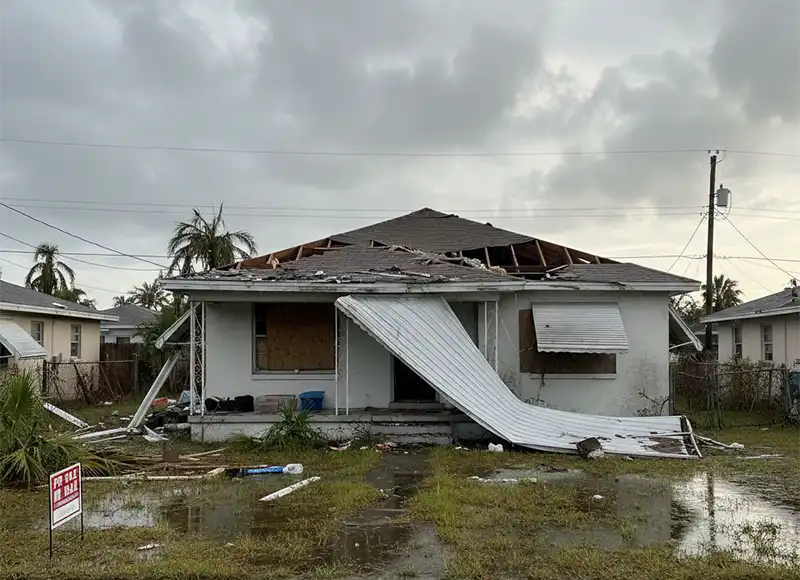
Document the difference before you clean up
Once the drywall is cut and the mud is hosed off, your proof is gone. Do this first:
- Photograph the water line in every room. Put a tape measure in the shot.
- Photograph the roof, soffit, and any ceiling stain from inside.
- Shoot wide video of each room before anything is moved.
- Keep a piece of cut drywall showing the high water mark.
- File with both carriers. Do not let one carrier tell you the other one owns it.
File both claims even if you think one will fail. A denial in writing is useful. Silence is not.
If you had no flood policy, you still have moves
Plenty of Shore Acres and Riviera Bay homeowners had no flood coverage in 2024. Their homes had never flooded, so no lender required it.
Two things still matter. First, press the wind portion of the loss. Roof, soffit, windows, and ceiling damage belong to your homeowners carrier no matter how high the water got.
Second, look at local aid. Pinellas County ran a Hurricane Home Repair Program for income-eligible homeowners hit by Helene or Milton, with grants up to $30,000 for repairs insurance and FEMA did not cover.
Neither one replaces flood insurance. Both beat writing the loss off.
Anti-concurrent causation, in plain words
Many Florida policies carry a clause about two causes acting together. The wording is dense. The effect is simple.
If an excluded cause like flood contributed to a loss, the carrier may argue the whole loss is excluded. Even where wind was also at work.
That is a legal argument, and it is answered with evidence and case law. It is one of the main reasons split-cause hurricane claims end up in litigation instead of at a settlement table.
Questions St. Petersburg homeowners ask
Does my homeowners policy cover storm surge?
No. Storm surge is treated as flood, and standard Florida homeowners policies exclude flood. You need an NFIP or private flood policy for surge damage.
Can I collect on both a wind claim and a flood claim for one hurricane?
Yes, when both perils caused damage. Surge may take the first floor while wind opens the roof. You file with both carriers and pay both deductibles.
How much is my hurricane deductible in Florida?
It is a percentage of your dwelling coverage, most often 2%, 5%, or 10%. Check the declarations page of your policy. On a $400,000 dwelling limit, 5% is $20,000.
My carrier blamed all the damage on flood. What now?
Ask for the written denial and the full claim file. Then get an outside engineer or roofer to separate wind damage from water damage in writing. That report is what moves a split-cause claim.
How long do I have to report hurricane damage in Florida?
1 year from the date of loss for a new or reopened claim, under Florida Statute 627.70132 . 18 months for a supplemental claim. Those windows were shortened in December 2022, so old advice may be wrong.
Get the line drawn in your favor
The wind and water split is not a technicality. It is where thousands of dollars are won or lost on a Pinellas County claim.
Cernitz Law litigates hurricane damage claims in St. Petersburg and handles denied and underpaid claims in Pinellas County . The firm has recovered results like a Hurricane Ian claim that moved from an $89,000 payment to a $600,000 settlement.
If your insurer blamed storm surge for damage that may have been caused by wind, Cernitz Law can review the claim, denial letter, and available evidence.
Request a Free Claim Review Or call (888) 683-2624